
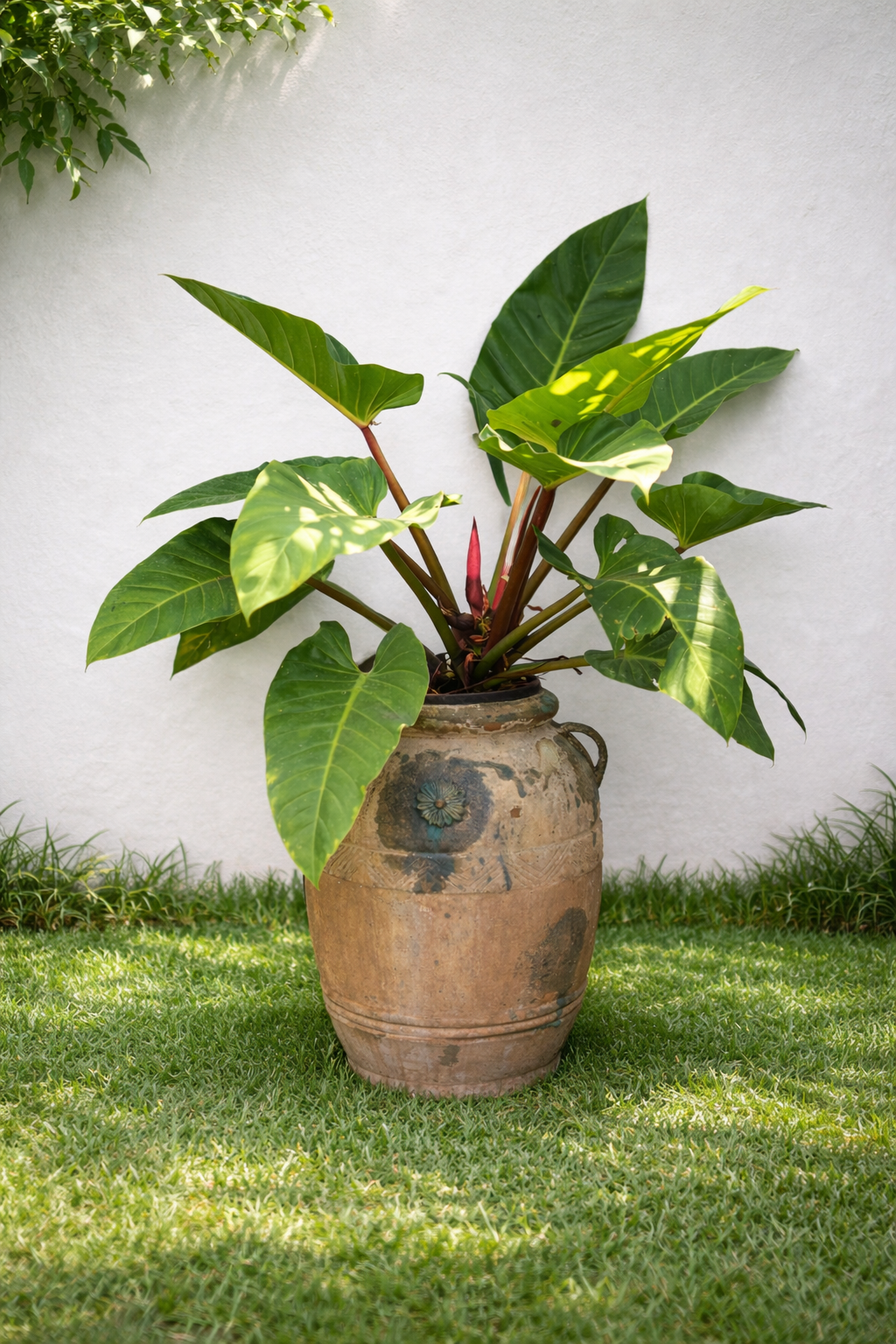
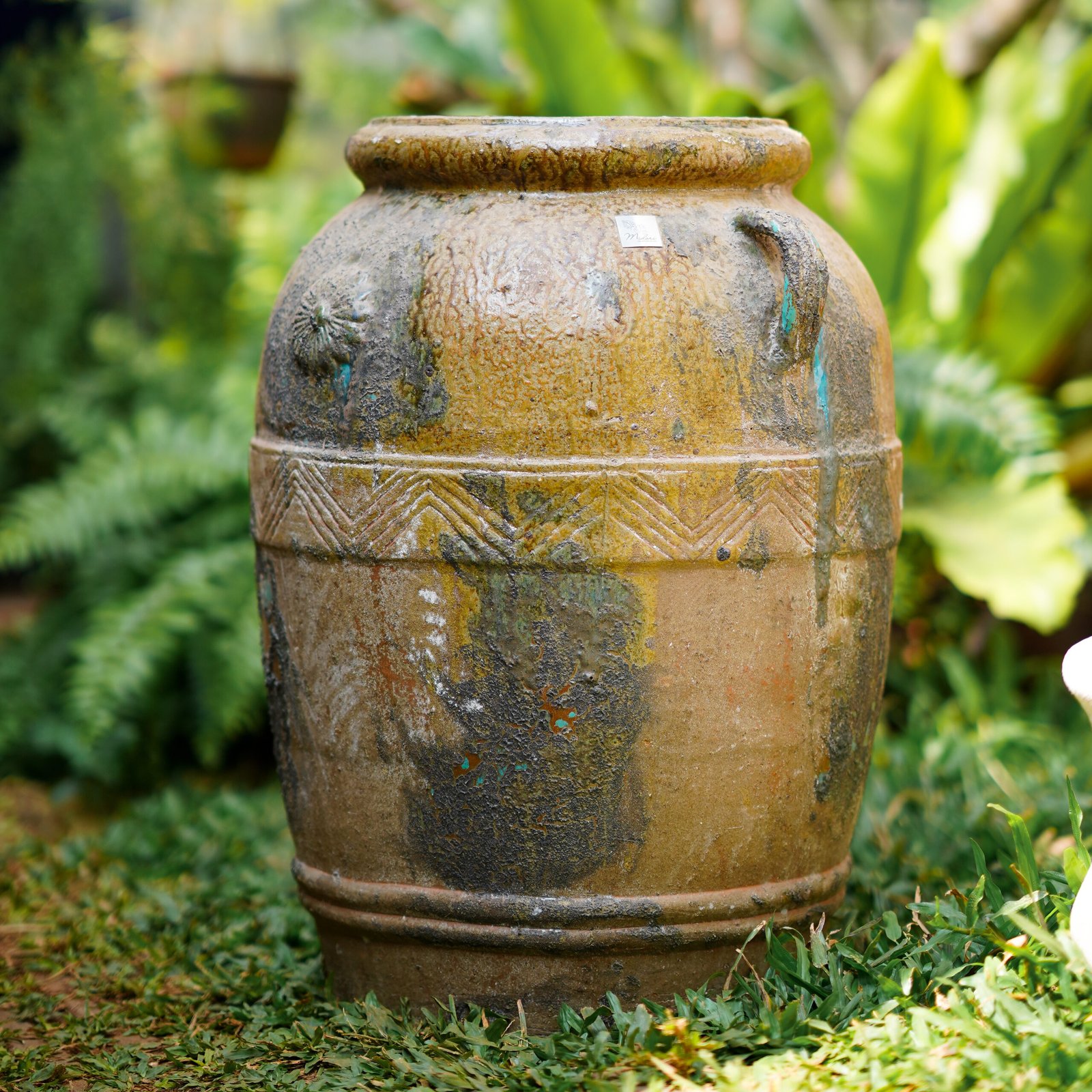

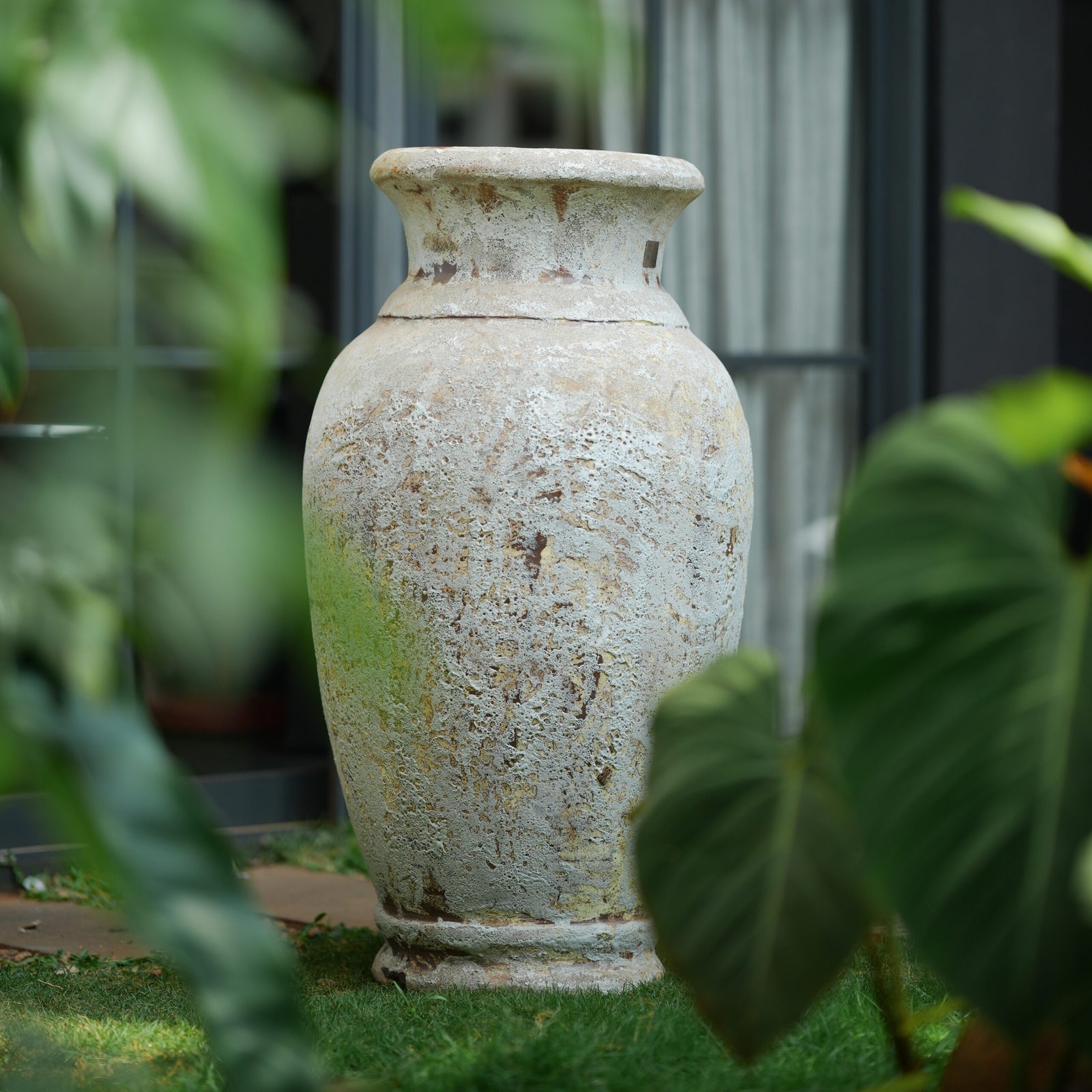
The Pithos Urn (pithos — the ancient Greek term for large storage jars of exactly this form) does not look made. It looks found.
A large, wide-shouldered terracotta jar with a thick rolled rim, two small applied ear handles at the shoulder, and a banded incised chevron frieze encircling the upper body — this is a form drawn from the oldest traditions of utility pottery. Vessels of this proportion and character have been used across South Asia, the Middle East, and the Mediterranean for millennia: for storing grain, oil, and water; for marking boundaries; for standing at the entrance of a home or temple. The Pithos Urn carries all of that association in its silhouette, without literal reference to any single tradition.
The surface is where time is most present. Ochre, charcoal, dark olive, raw sienna, and flashes of weathered teal are layered across the body in a finish that resembles a vessel that has spent decades outdoors — absorbing rain, algae, mineral deposit, and fire. The texture is thick and uneven: in places the surface bubbles and blisters like fired earth; in others it is smooth and worn; in others still, pigment has run and dried in vertical trails. The incised chevron band at the shoulder — a geometric pattern scratched into the clay before firing — catches the layered pigment and darkens within its grooves, reading as something ancient even in its detail.
The teal that appears at intervals across the surface is not a decorative addition. It emerges from the layering process — a colour that surfaces through successive applications and abrasions, as verdigris surfaces on aged bronze or copper. It is present, then absent, then present again as the eye moves around the urn.
Beena’s styling note
The Pithos is named for the large terracotta storage jars of ancient Greece — the vessels that held olive oil, wine, and grain in Minoan palaces three thousand years ago. This form has not changed because it has never needed to. Wide-bellied, narrow-necked, with small side handles that were made for rope, not decoration — the Pithos carries its history visibly in every curve.
It can be planted, but it does not require it. In case you decide to, then plant it with something that matches its scale and its drama. A large Philodendron Imperial Red, as shown, is the right instinct — broad tropical leaves in deep green and burgundy that erupt from the narrow neck and spread wider than the urn itself. A Bird of Paradise, a large Alocasia, or a clump of ornamental Canna will do the same. The Pithos can hold a significant root mass — plant generously, water deeply, and let the planting overwhelm the vessel slightly. That tension between ancient container and living tropical abundance is the entire composition.
Place it on an open lawn, in a garden corner, or against a plain white or stone wall where it can be read in full silhouette. It needs no companion pieces — one Pithos on a lawn is a complete garden moment. The dark fire-patina on the shoulder will deepen further outdoors. Leave it alone and let it age. In a year it will be even better than it is today.
Each Pithos Urn is hand-finished and entirely unique in its surface distribution. No two will be identical.
Care –
The Pithos is an outdoor vessel and asks for almost nothing in return.
Outdoors: Leave it entirely alone. Rain will deepen the fire patina, sun will warm the terracotta body, and the dark markings will develop further over months outdoors. This is not weathering — it is the Pithos ageing into itself. Water the plant within normally; the urn’s terracotta body will absorb and release moisture naturally, regulating the root environment without intervention.
Indoors or covered terrace: Wipe the exterior occasionally with a dry or barely damp cloth. Do not use chemical cleaners, sealants, or abrasive materials — these will strip the fire patina irreversibly.
Handling: The Pithos is a large, heavy vessel. Move it with two people and support the base — never lift by the side handles, which are decorative in character rather than structural.
A note on character: The fire patina, dark markings, surface roughness, and rosette relief are unique to each Pithos. No two are identical. Surface variation, natural crazing, and uneven colour are inherent to the high-temperature firing process — not defects. What looks like imperfection is provenance.





Reviews
There are no reviews yet.